Your team may already rely on SentinelOne for endpoint detection and response. That gives you important visibility into endpoint posture, detections, and protection status. The harder part starts after the alert, when the policy gap or coverage issue is identified. Someone still must sort the signal from the noise, decide which endpoint issues matter most, assign the work to the right team, and confirm the issue was really fixed. That is where Discern fits. Discern connects SentinelOne context with the rest of the stack, then helps teams validate controls, prioritize action, and move remediation into operational workflows. The result is not another endpoint dashboard. It is a clearer path from endpoint visibility to follow-through. Teams can see what protections are missing, where drift or gaps exist, what should be fixed first, and what should move into ServiceNow, Jira, or other systems next.
The agent story for SentinelOne
Discern uses six AI Agents to turn endpoint data into a working remediation loop. Together, they help teams move from assessment to insight, from prioritization to remediation, and from isolated fixes to a more consistent cross-stack strategy.
Example value by agent
Scout: Helps teams turn raw endpoint data into actionable health checks.
Mesh: Shows where endpoint controls are missing or inconsistent when SentinelOne is viewed alongside the rest of the environment.
Oracle: Explains why a protection gap matters in context instead of leaving teams with another generic finding.
Pathfinder: Narrows a long list of endpoint issues into the smaller set that poses the greatest risk first.
Resolve: Pushes work into tickets and workflows so teams are not stuck managing follow-up manually.
Atlas: Gives leaders a faster way to ask questions and see progress without waiting on custom reporting.
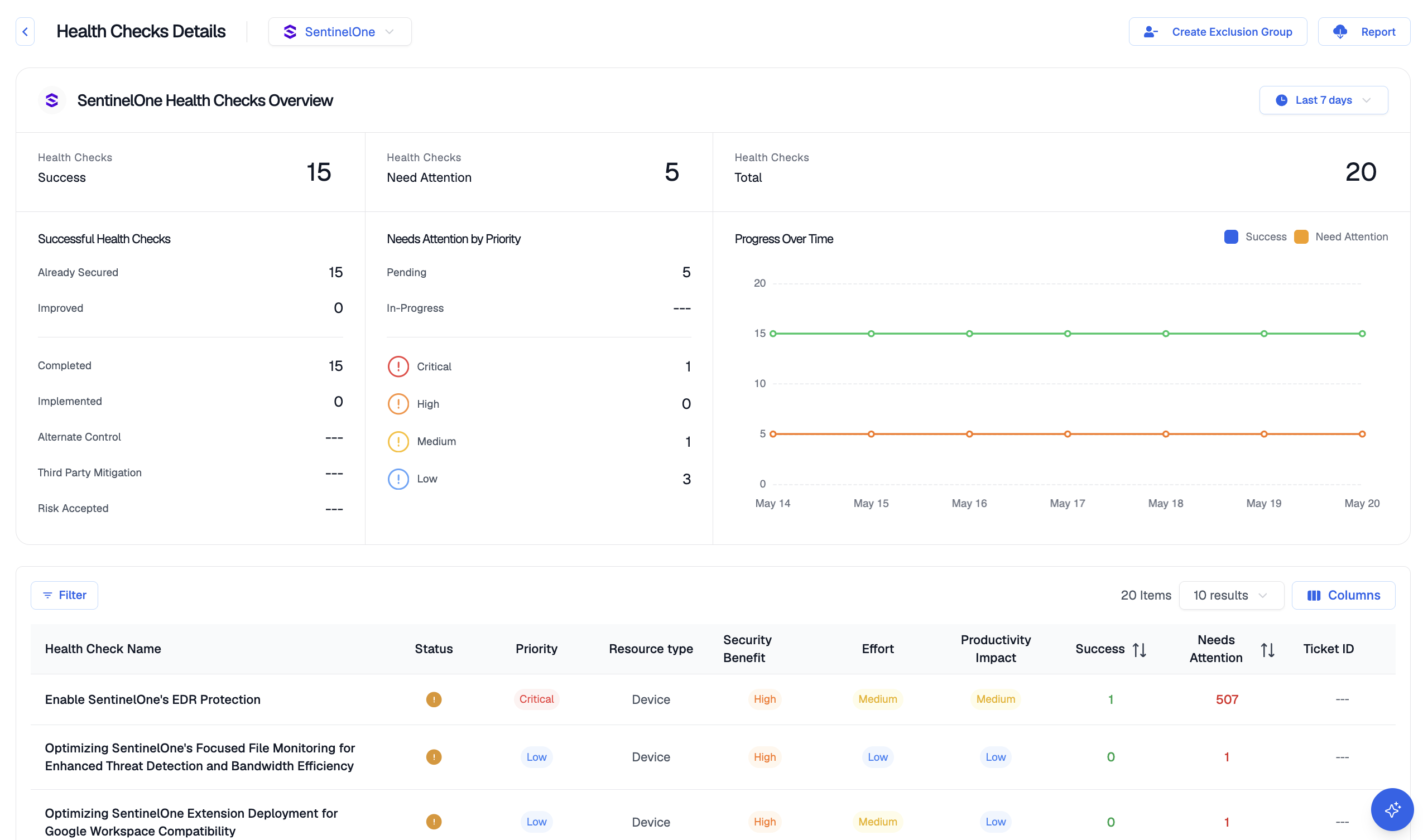
Most endpoint tools are good at surfacing alerts, detections, and policy status. They are less helpful when teams need to decide what matters most across hundreds or thousands of endpoints and then move that work through to completion.
That is the gap Discern is designed to close. Instead of handing teams another long list of findings, Discern helps sort the signal from the noise, connect endpoint issues to other controls and operational context, and move the right work into the systems people already use.
Traditional workflow
Analysts manually review endpoint alerts and findings.
Teams export data into spreadsheets or separate reports to prioritize work.
Tickets are opened one by one and routed by hand.
Security and IT teams spend time chasing updates across tools and owners.
Leaders still have to piece together whether the risk actually went down.
Discern workflow
Agents keep checking protection coverage and control effectiveness in the background.
Pathfinder narrows a long list of endpoint issues into the small set that matters most.
Resolve helps turn those issues into tracked tasks and approved remediation actions.
The Atlas shows what is closed, what is in progress, and where risk has been reduced.
Automated remediation: From SentinelOne finding to closed-loop fix
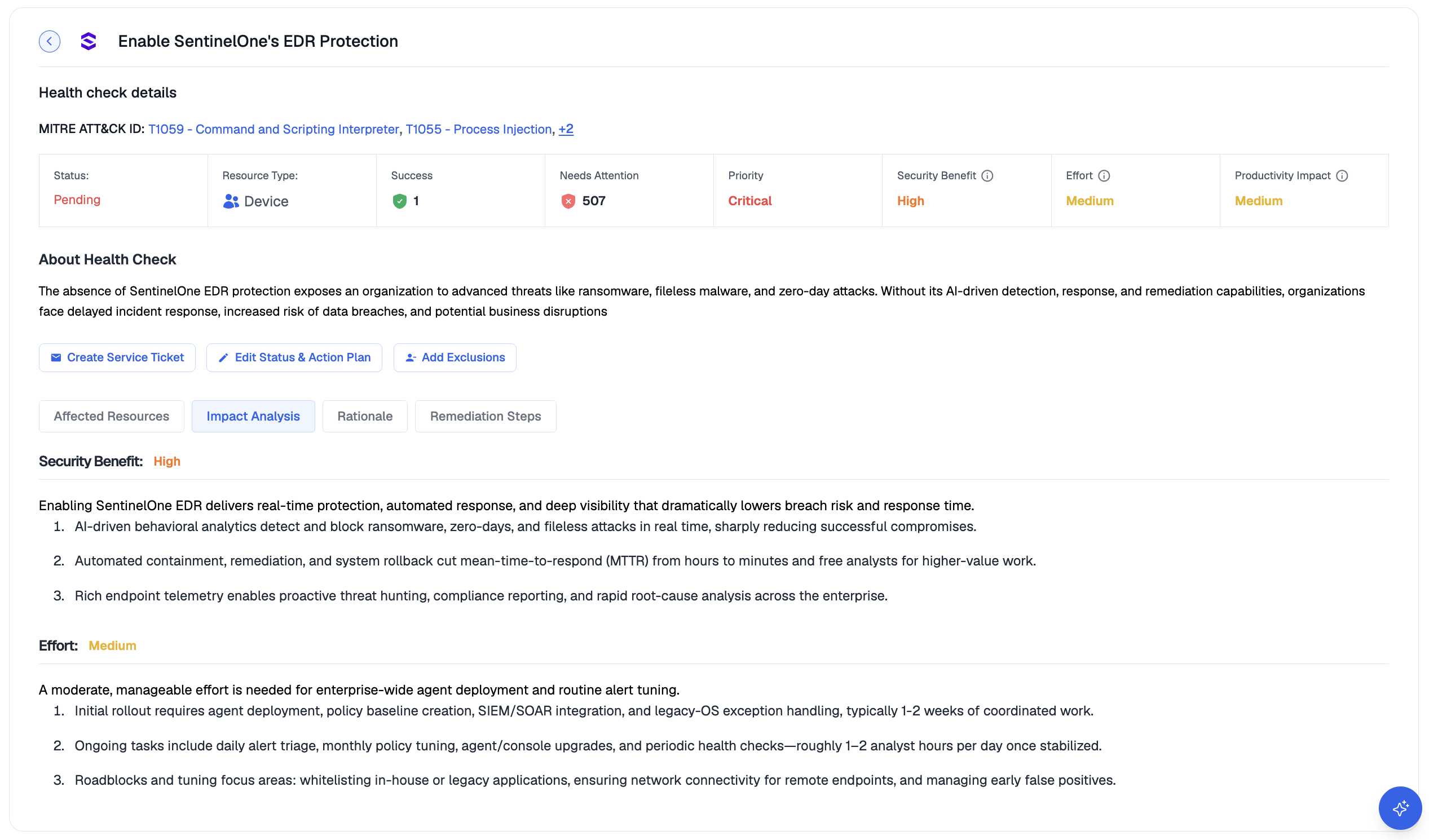
A detection, policy gap, or missing protection is only the start. What matters is whether the right team takes action, whether the endpoint issue is really addressed, and whether there is proof to show later.Resolve helps move that work forward. If teams identify missing endpoint protection coverage, policy drift, stale configurations, or a high-priority exposure related to endpoint posture, Discern can turn those findings into tasks that are easier to act on and track.
Detect the gap: Scout and Mesh identify protection gaps, missing controls, policy conflicts, or inconsistent coverage across the endpoint environment.
Prioritize the work: Pathfinder ranks affected endpoints using risk signals, business context, exposure, and likely impact.
Explain the action: Oracle provides teams with a plain-language explanation of why the issue matters and which remediation path makes sense.
Execute with guardrails: Resolve opens tickets, routes approvals, coordinates next steps, and can initiate approved remediation actions.
Verify and report: Atlas and Resolve help teams confirm what changed, capture evidence, and make progress visible in leadership reporting.
Real-world scenario
A security team sees that a group of high-value employee laptops has inconsistent endpoint coverage, and several machines are missing a required control. Discern helps isolate which devices create the highest risk, pushes the work into the existing ticketing system, and keeps the issue visible until the protection gap is closed. Instead of asking analysts to manage every follow-up manually, the workflow stays connected from finding to action to reporting. Leaders can then see which endpoint gaps were fixed, which remain in progress, and how the team is improving over time.
Benefits of using Discern with SentinelOne
Know whether endpoint protections are really working: Discern helps teams validate whether the controls meant to protect endpoints are present, configured correctly, and functioning as expected.
Reduce alert and remediation noise: Discern helps teams focus on the endpoint issues that matter most instead of treating every finding with the same urgency.
Get fuller context across the stack: Mesh connects endpoint data with identity, vulnerability, ITSM, CMDB, and other systems to uncover gaps and dependencies.
Move findings into action faster: Resolve helps turn findings into executable work and reduces manual effort in remediation workflows.
Support leadership and audit conversations: Atlas gives teams dashboards and reporting that show what has improved, what remains open, and how the organization is progressing over time.
Make better use of existing tools: Discern is built to work across customers' environments and integrate with the tools already in place.
How Discern works with SentinelOne
Connect to SentinelOne: Discern uses SentinelOne endpoint context as part of the broader connected environment Discern supports.
Normalize endpoint context: Scout creates a cleaner view of endpoints, ownership, criticality, and expected control coverage.
Validate controls continuously: Discern checks whether endpoint protections are present, active, consistent, and aligned with expected baselines.
Correlate across the stack: Mesh compares endpoint context with identity, vulnerability, CMDB, and workflow tools to reveal gaps and dependencies.
Prioritize Top Actions: Pathfinder ranks what should be fixed first using risk, exposure, effort, and business impact
Remediate and measure: Resolve helps operationalize the work, while Atlas makes the results visible in dashboards and plain-English reports.
Example security gaps Discern can surface
Exact checks depend on enabled APIs, customer configuration, and the other data sources connected to Discern. Representative examples include endpoint issues such as:
Devices missing expected endpoint protection coverage or required controls.
Inconsistent endpoint policy coverage across teams, business units, or device groups.
Endpoints with stale configurations, weak baselines, or missing enforcement of required settings.
Gaps between endpoint detections and the broader control environment when identity, vulnerability, or workflow context is considered.
High-priority endpoint issues that should move into remediation workflows immediately versus lower- priority findings that can wait.
Control gaps that map to broader security strategy and coverage discussions across the stack.
Business use cases and outcomes
Get more value from SentinelOne: Turn endpoint visibility into control improvements, prioritized remediation, and clearer follow-through instead of another reporting layer.
IFind risky endpoint gaps faster: Detect missing protections, inconsistent coverage, and control weaknesses with more context around what matters most.
Focus teams on the work that matters: Help security and IT spend time on the smaller set of actions that will reduce the most risk first.
Improve alignment across tools and teams: Use endpoint findings to inform broader decisions across identity, vulnerability, and operational workflows.
Reduce manual reporting effort: Atlas turns natural-language questions into reusable dashboards for QBRs, audits, and leadership updates.
Give executives a clearer progress story: Show what improved, what remains open, and where measurable risk reduction is happening.
Customer benefits
Stronger endpoint posture: Improve endpoint protection and control effectiveness by prioritizing and following through.
Fewer blind spots: Identify missing protections, drift, or under-protected devices by connecting SentinelOne context with the broader security stack.
Faster time to resolution: Move from finding to ticket, approval, execution, and verification with less manual coordination.
Audit-ready evidence: Track remediation progress and control status without rebuilding reports by hand every time.
More credible proof of improvement: Show progress through dashboards that connect endpoint work to broader risk reduction.
Experience the future of security with a collaborative mesh ecosystem powered by AI