
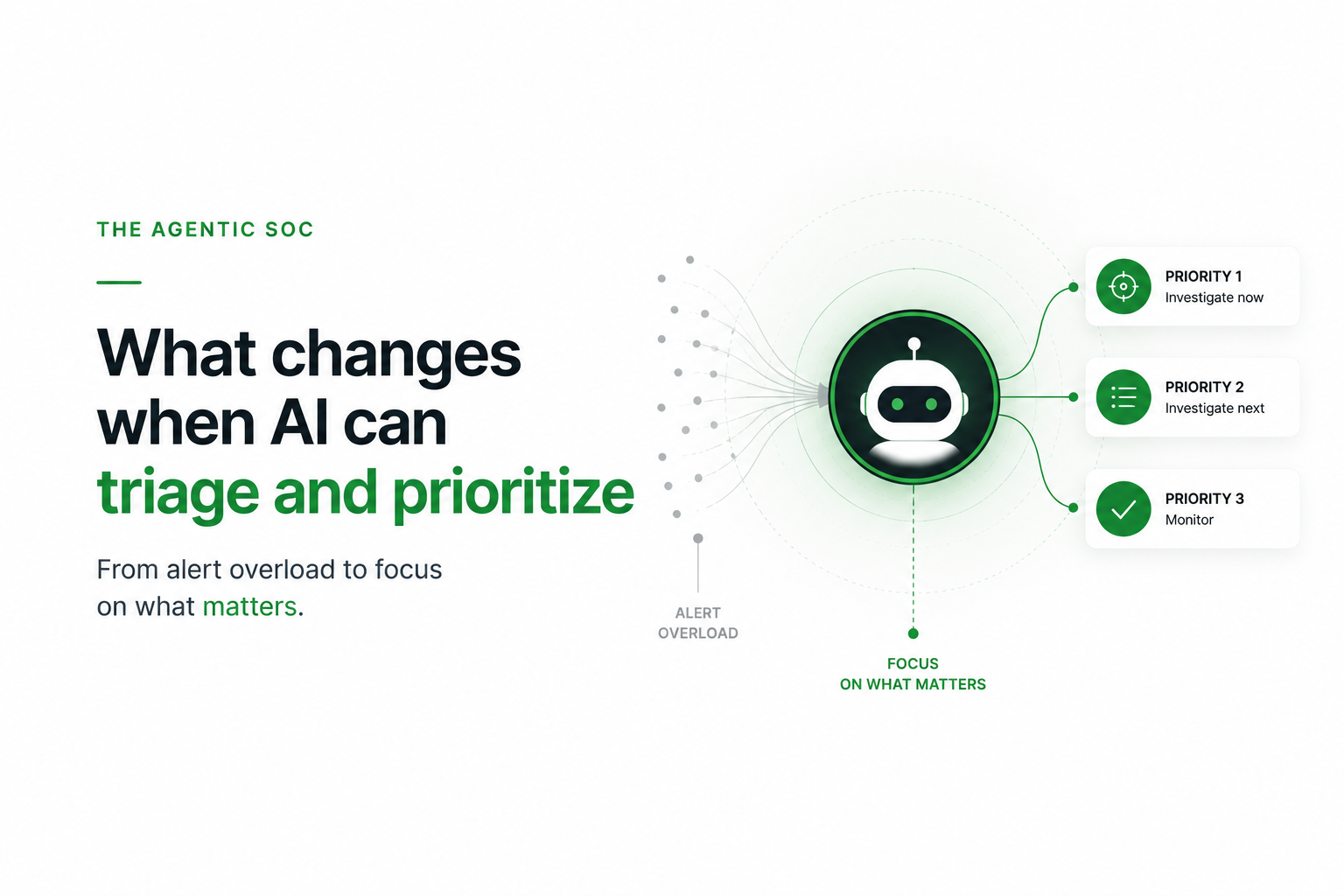

The security operations center has a math problem. Alert volume is rising, the attack surface is expanding, and skilled analysts are scarce. For years, the answer was to add tools, which in turn generated more alerts.
The agentic security operations center (SOC) hasa different answer: put AI agents to work on the parts of the job that don't need human judgment. Industry surveys of CISOs now treat AI-augmented operations as table stakes rather than a differentiator.
An agentic SOC uses AI agents to carry parts of the detect, investigate, prioritize, and respond workflow. Instead of a human triaging every alert, agents correlate signals, filter out noise, assemble context, and draft a prioritized response, escalating to people when something requires a decision. A common pattern uses cheap models for high-volume triage, an aggregation layer for correlation, and a frontier model for contextual reasoning at the top.
With an agentic SOC, three things shift: routine triage moves off the analyst's plate, the loop runs continuously rather than stopping between shifts, and the analyst's role moves toward orchestration and the judgment calls AI shouldn't make alone.
What doesn't change is accountability. A person still owns the outcome, and an agent acting on bad data will confidently do the wrong thing. Irreversible actions and anything touching access or production deserve a human in the loop.
Here's the part most agentic SOC conversations overlook, and where the industry consensus is now explicit: the fastest way to reduce alert load isn't faster triage. It's a stronger posture upstream. This is a place where controls are configured correctly, assets are actually covered, and gaps are closed before they generate alerts.
An agent triaging a flood is helpful. A posture that produces fewer floods is better. Continuous control and coverage validation are what make that posture real rather than assumed.
Discern Security works upstream of the SOC. By continuously validating controls, coverage, and configuration across your existing stack, you can reduce the exposure that triggers alerts and provide the SOC with prioritized, business-context-aware findings rather than raw severity. It's the management layer that makes whatever SOC model you run, agentic or not, work on better data.