
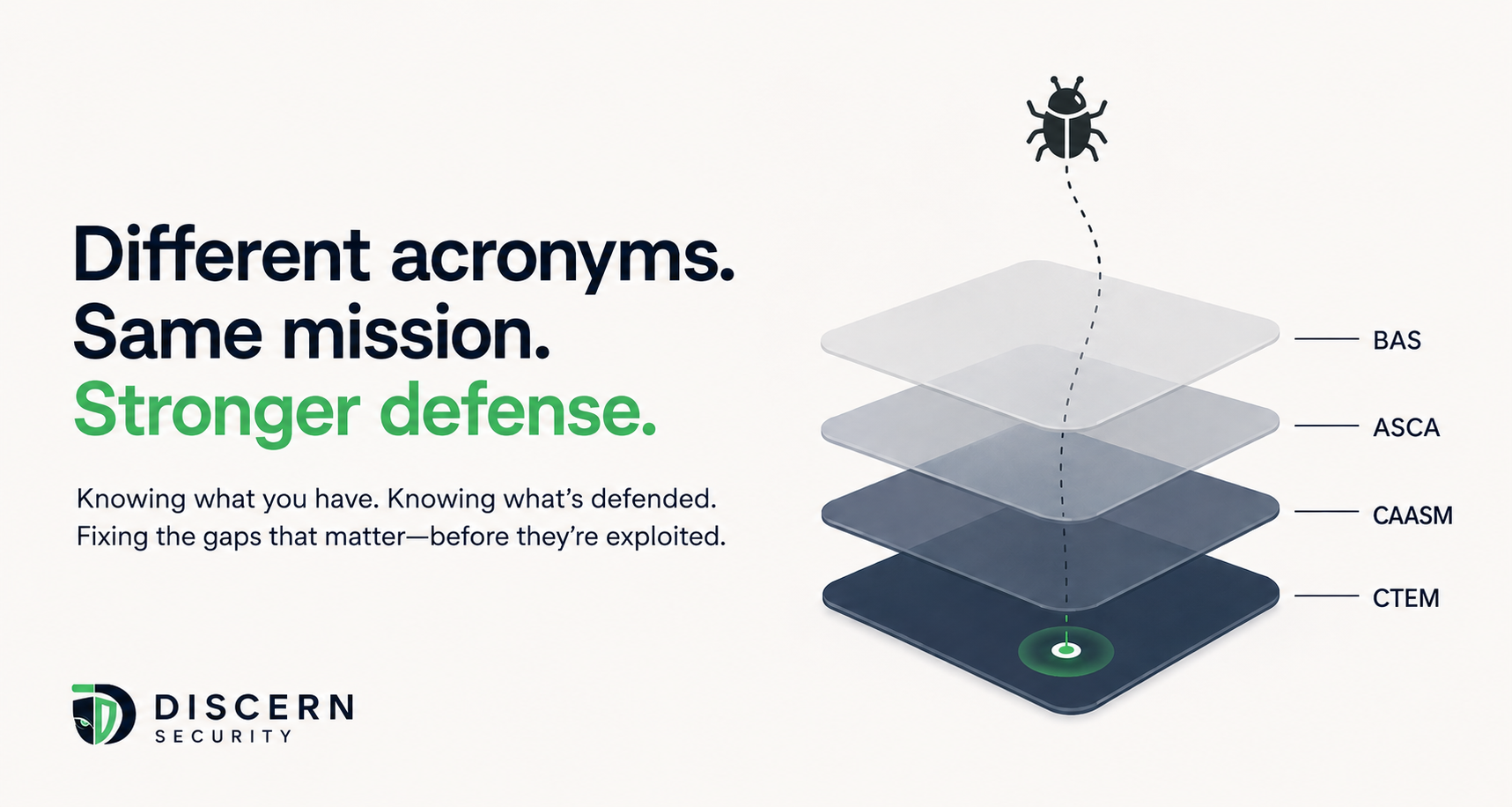

The window between a bug being discovered and a working exploit existing has collapsed from months to hours, and that shift is permanent. As elite offensive capabilities become cheaper and more automated, defenders face a flood of new findings. The instinct is to buy another tool, and the market has plenty of acronyms ready: CTEM, ASCA, CAASM, and BAS. Most of them describe pieces of one job: knowing what you have – knowing whether it's defended, and fixing the gaps that matter before someone reaches them.
CTEM (Continuous Threat Exposure Management) is a program, not a product. Gartner frames it as a five-stage loop: scope, discover, prioritize, validate, and mobilize. It replaces one-off scans with a continuous rhythm.
ASCA (Automated Security Control Assessment) is the discipline of continuously verifying that the controls you already own are properly configured. Gartner named the category because misconfiguration and drift remain a leading cause of incidents, and manual review doesn't scale across a multi-vendor stack.
CAASM (Cyber Asset Attack Surface Management) provides unified asset visibility, pulling data from your existing tools via APIs into a single queryable inventory of devices, users, software, and the controls protecting them.
BAS (Breach and Attack Simulation) safely emulates attacker techniques to test whether controls actually detect or block them, rather than assuming they will.
Read four vendor pages, and you'll see CAASM tools that validate controls, CTEM platforms that run simulations, and ASCA tools that prioritize fixes. The overlap is real because the underlying problem is shared. Every one of these is trying to answer the same executive question: are we actually protected, and if not, what do we fix first?
Here's what most of the commentary misses: attackers don't teleport. A vulnerability only matters if an attacker can reach it, and reaching anything in a well-architected environment means crossing layers. That's defense-in-depth, and it's the answer to this moment.
The problem is almost never the architecture; almost every organization already has a sound defense-in-depth design on a whiteboard. What they actually run is a half-deployed, drifted, partially configured version of the architecture they designed three years ago.
And identity is now the easiest layer to walk around: MFA gaps, stale OAuth grants, and over-privileged service accounts are doors that don't need a mantrap.
A program that makes the next AI-discovered CVE irrelevant to your business has to answer four questions continuously across the whole stack: how well configured are my controls, are all my assets actually covered, is my configuration hygiene holding, and which vulnerabilities actually matter given the controls already in place. Those are management questions, not tooling questions.
This is also where AI changes the category. The bottleneck was never a shortage of data. It was the human effort of reconciling controls, coverage, configuration and vulnerabilities across dozens of tools. That reasoning is what AI is good at, which is why continuous validation is becoming feasible where periodic review wasn't.
You don't need one product per acronym. You need the outcomes: a trustworthy inventory, controls that are deployed and configured correctly, prioritization based on the defenses actually in front of an asset, and reporting you can defend.
Discern Security sits above your existing tools as a management and optimization layer. It connects to what you already run and continuously reasons across control, coverage, configuration, and vulnerability data to show where your defense-in-depth model breaks down. The point isn't to replace your stack – it’s to make defense-in-depth real and continuously validated, so the architecture you already paid for actually holds.