
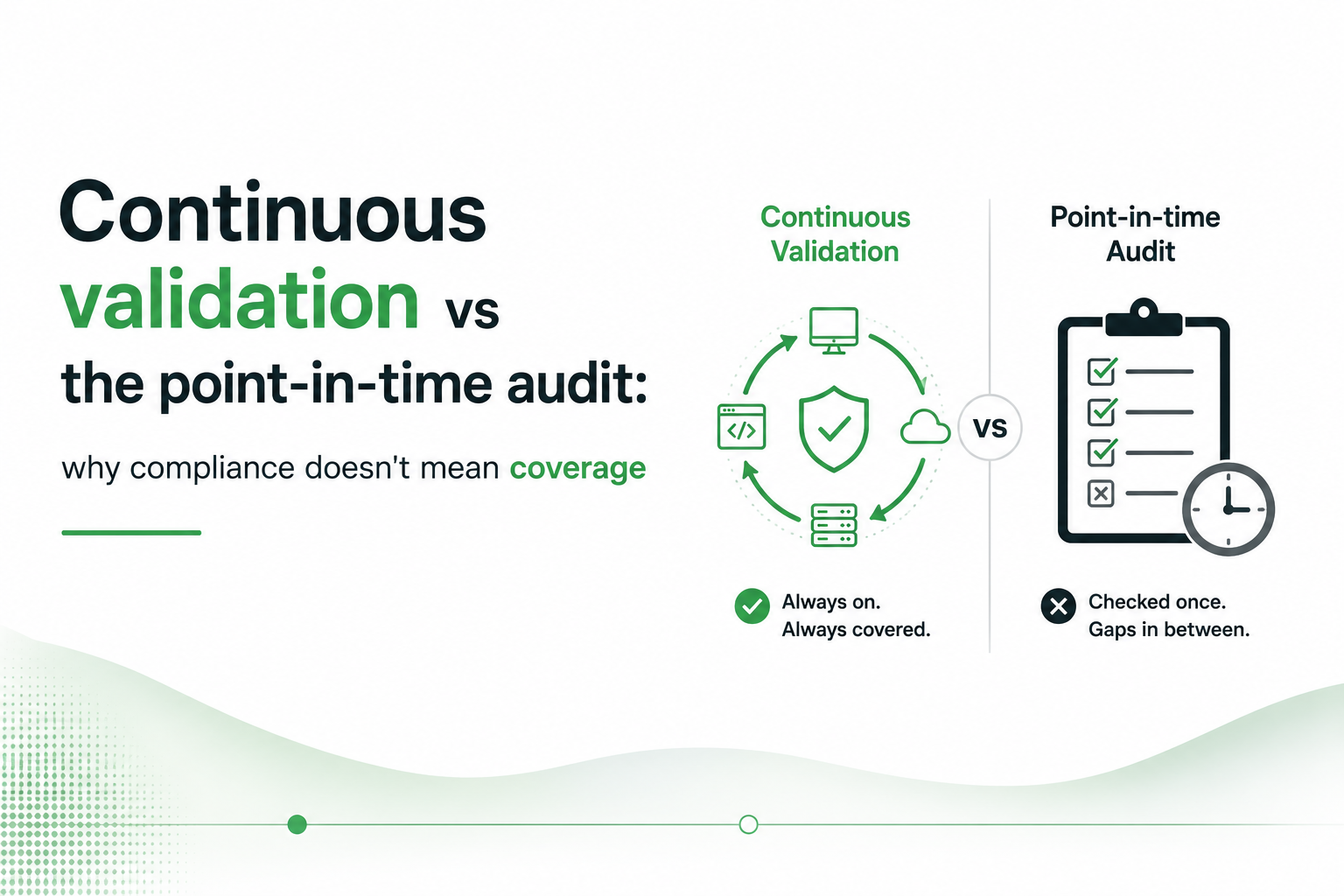

A clean SOC 2 report, a passed ISO audit, and a control signed off in last quarter's review. These feel like proof that your defenses are working. However, they're proof of something narrower: that the control held when it was sampled.
In a machine-speed threat environment, that's no longer the same thing as protection.
Point-in-time assurance verifies that a control existed and was configured correctly during an assessment window. Even a SOC 2 Type II, which observes controls over a period rather than a single day, samples that period and then closes the books; it tells you the control worked across a past window, not that it's working right now or will tomorrow.
That distinction is valuable for governance and required by regulators and customers. But an audit is a rear-view mirror, not a live feed. Golden images drift. Policies accumulate exceptions. Coverage erodes as new assets come online. None of that shows up until the next audit, if it shows up at all.
When offensive capability was scarce and slow, an annual or quarterly cadence left a tolerable window. That window has collapsed.
Security leaders increasingly describe the necessary shift in one phrase: from static assurance to continuous validation. The control set you attested to is only meaningful if it still holds under live conditions, not just during the audit period.
A program can be fully compliant and still carry significant exposure. The audit confirms a control is present; it rarely confirms that the control covers every asset, that prevention is enabled rather than detection-only, or that configuration hasn't drifted since the sample was taken.
The uncomfortable pattern, seen almost every time an environment is examined closely, is that what's on the architecture diagram and what's actually running have quietly diverged, and the gap is larger than the team expected.
Continuous validation doesn't replace the audit. It makes the audit defensible.
Instead of asserting that controls work, you can show, continuously, that they do: every control configured to standard, every asset covered, every drift caught, every vulnerability judged against the defenses in front of it.
When the board, an auditor, or an insurer asks whether the program is working, you have evidence rather than assertions.
Discern Security continuously reasons across your control, coverage, configuration, and vulnerability data to show whether your defense-in-depth model is actually standing, not just whether it passed last quarter. It maps to frameworks like CIS, NIST, and MITRE for audit-ready evidence, and turns point-in-time compliance into a continuous, defensible posture. The result is the same evidence your auditor wants, backed by proof that holds the other 364 days of the year.