

Industry commentary on AI-generated exploits misses the real problem.
The trend itself is undeniable. Mythos brought the issue into the boardroom, and the VulnCheck data backs it up: 40 CVEs attributed to Anthropic-affiliated researchers using Claude, including 28 high-severity Firefox vulnerabilities disclosed in just two drops. This will not be the last wave.
The window between bug discovery and a working exploit has collapsed from months to hours, and that shift is permanent. The industry's response, however, is moving in the opposite direction.
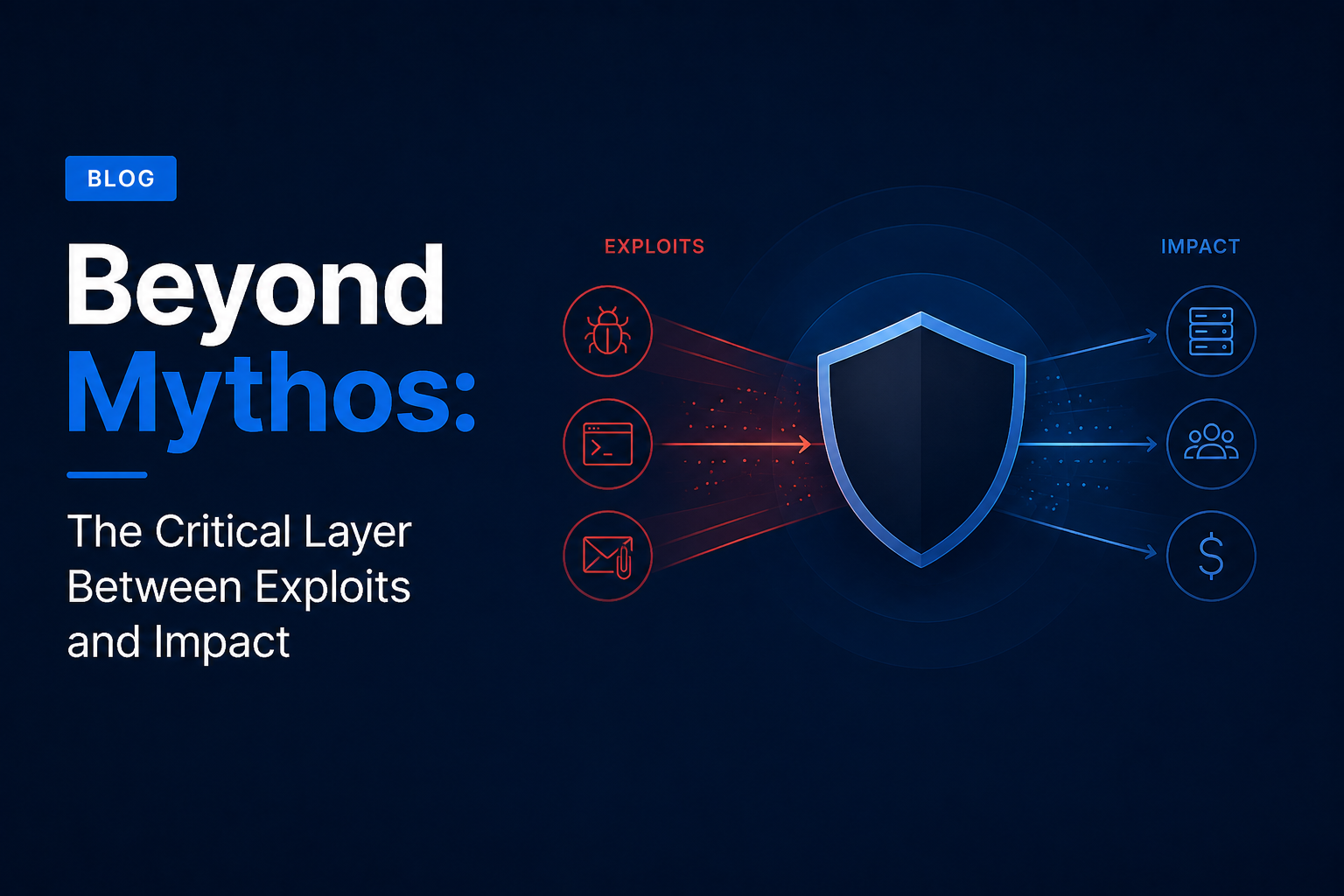
Mostpost-Mythos commentary misses a key reality: attackers don't teleport. A vulnerability only matters if an attacker can reach it. And reaching anything in a well-architected environment means crossing layers.
Consider the root password on your core router's console port. In isolation, it is a catastrophic vulnerability: full administrative access, no meaningful authentication, no logging, game over.
But to actually use it, someone has to reach the console port. That means making it all the way in – past badge readers and the mantrap, onto the floor, into the right cage, to the exact rack and device—without setting off alarms or tipping off the SOC. The vulnerability is real. It is also irrelevant to any realistic attacker.
That is defense in depth. It isn't a buzzword. It is the answer businesses need in this moment.
The honest caveat: the layers in front of your datacenter aren't the only ones that matter. Public-facing assets, cloud workloads, and above all, identity can give an attacker a path that skips the physical analogy entirely. That's the point. Identity is the new console port.
MFA gaps, stale OAuth grants, over-privileged service accounts, unmanaged SaaS tenants — these are the doors that don't require a mantrap to walk through. The layers still matter. They just have to cover every path, not just the ones that start at the front door.
Here is the uncomfortable truth: almost every CISO already has a well-designed defense-in-depth architecture on a whiteboard. Firewall at the perimeter. EDR on endpoints. SASE for remote access. WAF in front of applications. Email security. Identity is the real perimeter, with MFA, conditional access, and privilege boundaries. Network segmentation. Egress controls. Vulnerability management. A plan for every layer.
The architecture is sound. The deployment is the problem. What most organizations actually have is a half-deployed, drifted, and partially configured version of the architecture they designed three years ago.
Consider this: EDR is on 87% of endpoints, not 100%. The SASE rollout stalled at the third business unit. The WAF is in detection mode on half the apps. Three email security policies are running in “monitor” because nobody wants to be the person who blocks a CEO's email. Segmentation exists between tiers but not within them. The golden image drifted six months after it was published.
The hard part is that these gaps are rarely visible in one place. They sit across tools, policies, exceptions, identities, assets, and configurations, too many layers for humans to continuously reconcile manually.
This is security debt. And in the post-Mythos era, security debt is what attackers actually exploit. They don't need a novel zero-day. They need the layer you never finished deploying.
A defense-in-depth program that actually works, the kind that makes the next AI-discovered CVE irrelevant to your business, must continuously answer four questions::
These sound like simple questions, but answering them manually across EDR, SASE, WAF, identity, cloud, email, SaaS, and vulnerability data is where most teams get stuck.
You do not need a new platform.. Instead, focuse on three moves, none of which require a budget cycle:
None of this requires outside help, but all of it will tell you whether your architecture on paper matches your architecture in production.
Ultimately, you will find that the challenges you face in your architecture are a management problem, not a tooling problem. You already bought the tools. What's missing is the layer that tells you, continuously and honestly, whether your architecture is actually meeting your needs and requirements. That is Discern.
Discern AI continuously reasons across your security layers to identify the control gaps, coverage gaps, and configuration drift that are almost impossible for humans to track manually at scale.
Nearly every time a new customer connects their stack, we see the same thing: the architecture diagram and the configuration don’t match. Controls that everyone assumed were fully deployed are only partially deployed. Controls that were fully deployed a year ago have drifted. Assets that should be covered by three tools are covered by one. The gap is never zero — it is almost always larger than the team expected.
Discern connects to the security and IT tools you already own (EDR, SASE, WAF, email security, IdP, cloud, vulnerability management) and gives you a single source of truth across all of them.
The result is a defense-in-depth program you can actually defend: every layer visible, every gap prioritized, every improvement measurable. And when your board asks whether the program is working, you have evidence, not assertions.
Mythos did not break defense-in-depth. It made the cost of incomplete defense impossible to ignore..
The companies that survive this era will not be the ones with the fastest patching program. They will be the ones whose architecture on paper matches their reality in production, with every control fully deployed, every asset covered, every configuration held to standard, and every vulnerability judged in the context of the layers around it.
You may already own the badge readers, the mantrap, the cameras, the cages, the locks, and the segmentation presented as EDR, SASE, WAF, MFA, email security, and the rest of the stack. The work now is finishing the build, proving it holds, and making it easy to keep it that way.
Discern AI identifies where the intended defense-in-depth model breaks down — which controls are missing, misconfigured, drifting, or failing to protect the assets and users they were supposed to protect.
That is the work Discern is built for.