

Most breaches don't start with a clever zero-day vulnerability. They begin with a control that was deployed but configured poorly, drifted over time, or quietly stopped covering part of the environment.
Consider this: EDR is on 87% of endpoints, not 100%. The WAF is in detection-only mode on half of the apps. A golden image drifted six months after its publication. That gap between owning a tool and having it work is what Automated Security Control Assessment, or ASCA, exists to close.
Gartner describes ASCA 1 as “technology that continuously analyzes and optimizes deployed security controls, identifies configuration drift, policy deficiencies, weak defaults, and detection gaps, and recommends or assists with remediation.”
The reason ASCA matters now is simple: manual control review can't keep pace with a stack that spans dozens of vendors, against adversaries operating at machine speed.
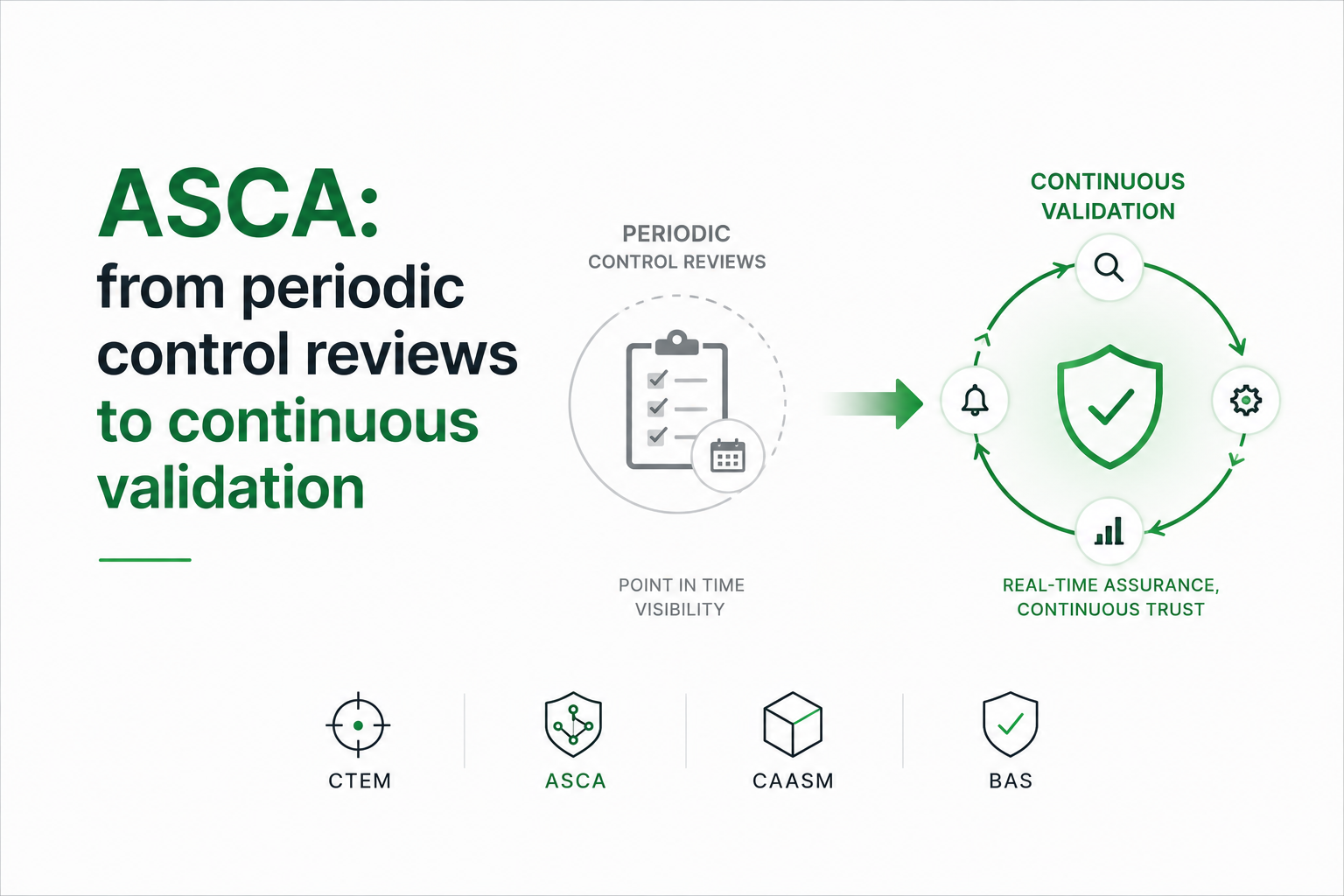
The traditional model was point-in-time: review configurations against best practice, write a report, move on. However, bythe time the report is read, the environment has changed. A control correctly configured on day one but drifted for two years provides false assurance. A quarterly snapshot tells you how secure you were then, not how secure you are today.
ASCA shifts the model from snapshot to stream. Instead of assessing once a quarter, the platform continuously monitors configuration: detecting drift as it happens, comparing settings against benchmarks, and surfacing the specific changes that weaken protection.
The output isn't a static report. It's a live answer to whether your defenses are holding right now. AI is what makes this practical, because reasoning over configuration across many products and ranking fixes by impact is exactly the work people find tedious at scale.
Knowing a control is misconfigured only helps if you also know which fixes matter most. Good ASCA pairs detection with prioritization, ranking gaps by security benefit and business context rather than listing every deviation.
The question isn't “do I have EDR?” Everyone has EDR. The question is whether prevention is on, exclusions were reviewed this year, and the policy matches your real access model.
Discern Security's Control Assessment and Configuration Health capabilities map directly to ASCA. The platform connects to your existing controls, shows how well each is configured against best practice, catches drift before it becomes an incident, and prioritizes remediation by impact.
It's the management layer that ensures the tools you already pay for are deployed, operational and validated, so you get more protection from the stack you own rather than buying another one.
1 Gartner, “Innovation Insight: Automated Security Control Assessment,” Evgeny Mirolyubov, 10 January 2026